
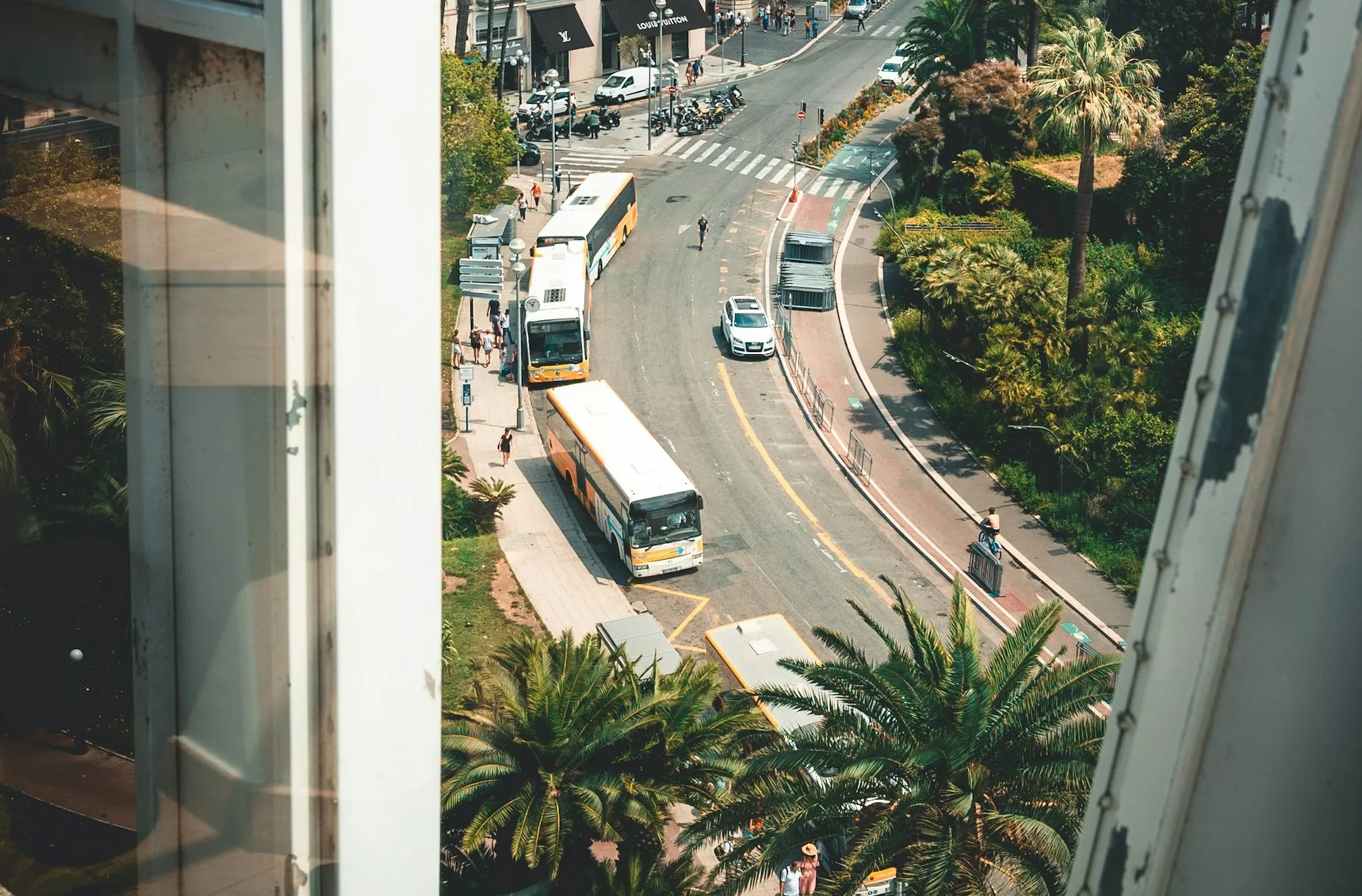
The Côte d’Azur looks compact on a map. Nice to Cannes is 33 kilometers, Nice to Monaco is 20. People arriving from London or Los Angeles look at those numbers, decide any of it is commutable, and sign a lease accordingly.
Some of those commutes are genuinely easy. One of them is among the better daily journeys you’ll find anywhere in Europe. And one is a trap that looks fine on a map and costs you ninety minutes a day in traffic.
The difference isn’t distance. It’s whether your route follows the coastal railway or fights the A8. This guide takes the four commutes people actually ask about, gives each a real door-to-door time and an honest verdict, then covers the reverse commute for anyone priced out of Nice. For how tickets and passes work, our guide to public transport on the French Riviera covers that in detail, and this one doesn’t repeat it.
Why the A8 decides every Riviera commute
One motorway carries this entire coast, and understanding it explains every verdict below.
The A8 runs the length of the Alpes-Maritimes, roughly 100,000 vehicles a day. The problem isn’t the volume so much as where it concentrates. Every morning at peak, more than half the traffic heading west takes exit 44 for Antibes and Sophia Antipolis. After 5pm the whole flow reverses, with drivers rejoining at Antibes Est to head back toward Nice.
So the A8’s worst congestion sits exactly on the route between Nice and the coast’s biggest employment cluster. That’s not incidental. It’s the commute, and it’s why the same trip can take 35 minutes at 10am and well over an hour at 8am.
The coastal railway runs parallel to all of this and is completely unaffected by it, so every verdict below comes down to which of those two you’re on.
Nice to Sophia Antipolis: the one that catches people out
This is the commute that matters most, because Sophia Antipolis is where most of the coast’s English-speaking tech jobs are. It’s also the one nobody explains properly, because it has two legs and the second one is invisible on most maps.
Sophia Antipolis has no train station. The business park sits in the hills above Antibes with two ways in, and most people find the obvious one and never hear about the faster one.
The direct coach, line 630. There is a coach straight from Nice to Sophia Antipolis, numbered 630 and renumbered from the 230 that older pages and long-time residents still call it. It starts at the Nice Vauban bus station, crosses the city center with a stop at Albert 1er, then runs west along the Promenade des Anglais, calls at the airport, and joins the motorway at Santoline. A variant numbered 632 makes two morning runs from the Grand Arénas interchange beside the airport instead. A sister line, the 631, does the same trip via Nice Nord, starting at Alsace-Lorraine and running out along Gambetta.
From Gambetta / Promenade, the first timed stop on the seafront, ZOU!‘s timetable gives about 55 minutes to the Sophia bus station off-peak and around 70 minutes for the 8am departures. Starting from Vauban adds another 15 to 20 minutes. Between 6:30 and 9am a coach passes Gambetta roughly every 10 to 15 minutes; after that it drops to about one every 45 minutes until the evening peak. It runs Monday to Friday only, with nothing at weekends or on public holidays, and some peak runs are dropped over Christmas and from mid-July to late August.
Three things to know before you rely on it. It runs on ZOU or multimodal fares, so a standard Lignes d’Azur ticket is not valid and you’ll want a Carte Azur or a Pass Sud Azur, though you can also buy from the driver. It can’t be used for local hops: heading to Sophia you can’t get off before 3 Moulins or board after Bois de Boulogne, and coming back you can’t board after 3 Moulins or get off before Santoline. Both rules are printed on ZOU!‘s current timetable for the 630 and 632, which is worth having on your phone. And it reaches Sophia by motorway, so that 70-minute peak figure is the timetable already admitting it sits in the exit 44 queue.
The train and the connecting bus. Take the train to Antibes, then the Line A bus-tram from the station interchange up into the park. Line A isn’t an ordinary bus: it’s a bus à haut niveau de service, a bus-tram running on dedicated lanes with priority at junctions, which is why it holds its timings better than the traffic around it.
The train does Nice to Antibes in about 20 minutes. Line A then takes 28 minutes from Antibes station to the Sophia bus station on the first departure, rising to 40 to 42 minutes through the morning peak and settling at 35 to 38 through the middle of the day. At peak it runs roughly every 10 minutes. Call it an hour door to door with the interchange, and a little over that at the worst of the peak.
The connecting leg also costs nothing. Envibus issues a free Pass Navette covering lines A and B, so on this route you pay for the train and nothing else.
The verdict: workable either way, and closer than it looks. Both routes land around the hour mark, so this isn’t the route I first assumed. The honest split is reliability against simplicity.
The two-leg route wins when it matters most. At 8am the direct coach is scheduled at roughly 70 minutes from the Promenade, and the train plus Line A comes to about 65 to 70 once you allow for the change. The times are close; what separates them is that the train leg cannot be delayed by the A8 at all, so your variance is confined to the shorter half of the trip. The direct coach wins on simplicity, has no interchange to miss, and off-peak it’s the faster of the two at about 55 minutes.
Pick by where you live, not by which sounds easier. If you’re near Nice-Ville station, take the train. If you’re along the Promenade or out west near the airport, the 630 probably passes closer to your door than the station does. Either way, check the connecting leg against your actual start time, because that’s what sets your margin for error.
Nice to Monaco: the easiest commute on the coast
Monaco is the one that surprises people, because it sounds like the hardest and is actually the simplest.
The train takes about 20 minutes from Nice-Ville, with 65 return trips a day. Monaco’s station is built into the rock in the middle of the Principality, so you arrive centrally rather than on the outskirts. Once you’re there, the CAM buses cover the districts, and a two-zone Pass SudAzur covering Nice and Monaco includes them along with the train.
Driving is the bad option here by a wide margin. The Basse Corniche is slow and scenic rather than quick, the A8 approach funnels into a small number of exits, and Monaco parking is expensive and tightly managed.
The verdict: the best commute on this list. Twenty minutes, no traffic, arriving in the center. Plenty of people who work in Monaco live in Nice deliberately, because Nice rent is dramatically lower than Monaco’s and the journey costs them almost nothing in time.
One thing to sort out before you start: Monaco is not in the EU, so if you’re carrying a SIM from another EU country your plan may bill Monaco as international roaming. French plans have treated Monaco as domestic since March 2024, and the public transport guide explains what changed.
Nice to Cannes: fine on the train, painful by car
Cannes is the longest of the four at about 35 minutes by train, but the service is dense, with more than 140 return trips a day, and it runs from before 5:30am to after 11pm.
By car this is the stretch of the A8 that seizes up in both directions at peak, and it’s the one that most often appears in traffic bulletins as fully blocked between Nice and Cannes.
The verdict: workable daily on the train, and don’t attempt it by car at peak. Thirty-five minutes each way is a real commitment over a five-day week, so it’s a better fit if you can work from home part of the week. If you’re doing it five days, look hard at Antibes as a middle option.
Nice to Antibes: the easy one nobody plans for
Twenty minutes, more than 140 return trips a day, and a station that sits close to the middle of town.
The verdict: barely a commute. It’s the shortest of the four and the most forgiving, and it’s the one to consider if you want a shorter journey than Cannes without the second leg that Sophia requires. Antibes also gets you Envibus at the far end, the cheapest network on the coast at €1 a journey and free on the A and B bus-tram lines, which matters if your workplace is a walk-plus-bus from the station.
The reverse commute: living outside Nice
Not everyone is starting from Nice, and plenty of people move out precisely because Nice rent is the biggest line in their budget. The reverse commute changes the calculation in two ways worth knowing.
You’ll usually be going against the flow. The A8’s peak is directional: west toward Sophia and Antibes in the morning, back east toward Nice from 5pm. If your commute runs the other way, you’re driving against the heavy direction, which is a real advantage and one of the few arguments for a car on this coast.
But the network thins as you leave the railway. Living in Vence, Grasse or an inland village means the coastal train is no longer at the end of your street, and the bus that connects you to it may run a handful of times a day. Our guide to where to live in Nice covers how much this varies even inside the city.
The honest version: the reverse commute works well if you land in another town on the railway, like Antibes, Cagnes-sur-Mer or Menton, and gets difficult quickly once you’re in the hills, however cheap the rent looks.
What a Riviera commute actually costs
The cost comparison is less close than people expect, for one reason that has nothing to do with fares.
Which pass you need depends on whether the train is part of the trip. A Carte Azur at €52 a month covers every bus and tram network in the Alpes-Maritimes, including the ZOU! 630 coach to Sophia, but not the train. For the rail commutes on this page you need a Pass SudAzur, priced by zone: €69 a month for two adjoining zones, which covers Nice to Antibes, Monaco, or Sophia by train and Envibus, and €80 for three, which Cannes needs because its zone doesn’t touch Nice’s. Our public transport guide has the full fare table, and our cost of living guide sets it against the rest of a monthly budget.
Then there’s the part most new arrivals never claim. Private employers in France are legally required to reimburse half the cost of a commuting subscription, and public sector employers cover 75%. That takes the €69 two-zone pass to €34.50 a month for most people, and the three-zone pass for Cannes to €40.
Against that, a car costs you fuel, the A8 toll, insurance, and parking at the far end before you even count the time, and thirty-five euros a month isn’t a close contest with any of it.
Which Côte d’Azur commutes are worth doing
| Route | Train time | Verdict |
|---|---|---|
| Nice to Antibes | about 20 min | Easiest. Barely a commute. |
| Nice to Monaco | about 20 min | Best on the coast. Arrive centrally, skip the traffic. |
| Nice to Sophia Antipolis | about an hour either way | Workable. Train plus Line A at peak, direct 630 off-peak. |
| Nice to Cannes | about 35 min | Fine by train. Avoid by car at peak. |
The pattern is consistent enough to state plainly: if your commute follows the coastal railway, it works, and it costs €34.50 to €40 a month once your employer pays their half. If it fights the A8 at peak, it doesn’t, whatever the map says about the distance.
Before you sign a lease, do one thing. Check what stands between your front door and a station, and between the far station and your desk. That last mile at either end is what decides whether a commute on this coast is twenty minutes or an hour, far more than the kilometers in between.
Sources
- Lignes d’Azur, interurban lines serving the Métropole Nice Côte d’Azur
- ZOU!, lines 630 and 632 Nice to Sophia timetable, valid from 22 December 2025 (PDF)
- ZOU!, line 631 Nice Nord to Sophia timetable, valid from 22 December 2025 (PDF)
- Envibus, fare range including the free Pass Navette
- Envibus, Line A route and stops
- Envibus, Line A timetable (PDF)
- SNCF TER, ZOU! sur la Côte d’Azur
- Lignes d’Azur, Guide des tarifs, July 2026 edition (PDF)
- Lignes d’Azur, Pass Multimodal: Carte Azur and Pass SudAzur fare tables