
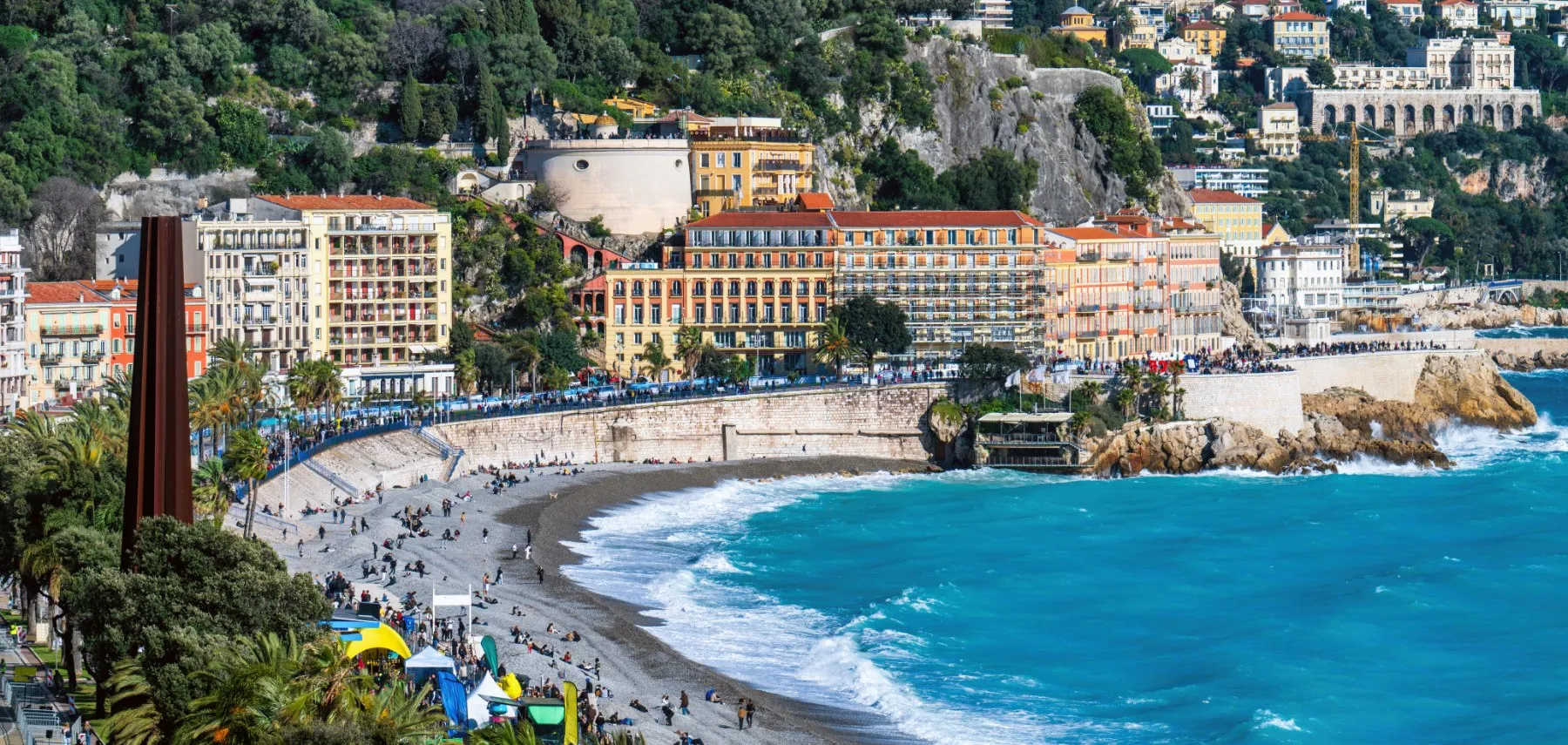
Most people work out what a move to the Côte d’Azur costs and stop there. The deposit, the removal van, the visa: all of it lands in one painful month and then it’s done. What matters more is the number that repeats every month afterward, and that one is harder to find. The figures quoted online are usually holiday-week prices or averages for the whole of France, and neither one tells you what a resident here pays in an ordinary month.
This guide covers what living here costs once you’re settled: rent, utilities, transport, food, health cover, childcare, and the taxes a resident still pays. For the one-off costs of arriving, the full breakdown of relocation costs covers deposits, agency fees, shipping and car registration separately.
A word on where the Riviera premium actually falls, because it isn’t spread evenly. Rent here is roughly double the national picture: the government’s rent map puts the median French commune at €10 per m² a month, and Nice at €20.43, higher than 99% of the 34,900 communes it covers. Only Paris beats the coast consistently, at €28 to €38 per m² depending on the arrondissement, while Lyon sits around €16 to €17 and Marseille €14 to €18.
Rank the whole country and the picture is blunt. Île-de-France is the most expensive region to rent in France, and Provence-Alpes-Côte d’Azur is next among mainland regions. By department, the Alpes-Maritimes comes fifth behind Paris and its immediate suburbs, which makes this coast the most expensive place in France to rent an apartment outside greater Paris.
Nothing else on this list carries a multiple like that. Some of it genuinely is set nationally, notably the CAF scale that prices a municipal crèche place. Some of it isn’t: your tram pass is priced by the local network, your mutuelle quote depends partly on your postal code (DREES finds place of residence is used to price contracts for half of beneficiaries, because the cost of care varies by area), and the weekly shop varies with which supermarket you can reach on foot. Those differences are real, they’re just measured in euros rather than hundreds of euros.
What renting actually costs each month in Nice, Cannes, Antibes and Menton
Rent decides your budget, so start here. These are residential rents for people living here year-round; seasonal and vacation rentals run on a different market entirely.
The figures below come from the government’s carte des loyers (national rent map), which models advertised rents commune by commune. They cover unfurnished apartments, they include building charges, and they are based on rentals advertised in the third quarter of 2025.
| Town | All apartments, € per m² | Small apartments (T1–T2) | Larger apartments (T3+) |
|---|---|---|---|
| Menton | €21.06 | €23.42 | €20.40 |
| Nice | €20.43 | €22.74 | €19.73 |
| Cannes | €20.27 | €22.80 | €19.51 |
| Antibes | €20.25 | €22.74 | €19.73 |
The four towns cost roughly the same to rent, which is not what their reputations suggest. Per square meter they sit within a euro of each other, and Menton, the town everyone calls cheap, is nominally the most expensive of the set. Small apartments cost more per square meter than large ones everywhere, which is why a studio never feels like a bargain.
The gap people actually feel between towns comes from what a typical apartment looks like rather than the rate per square meter: more space for the money in Menton and inland Antibes, less in central Nice and along the Croisette. Villefranche-sur-Mer, for comparison, runs at €26.41 per m², so the small coastal villages are where the real premium sits.
Treat the per-m² figure as a starting point rather than a quote. Within Nice the modeled range runs from about €15 to €27 per m² depending on the neighborhood, and proximity to the sea moves it more than anything else.
In practice, for an apartment in Nice, these are the ranges you’ll see advertised. The left-hand column is what the citywide rate buys you: residential areas away from the water, so Riquier, Saint-Roch, the streets north of Libération, Nice Nord. The right-hand column is what the same apartment costs once you’re in or beside the center, meaning Vieux-Nice, the Carré d’Or, the Port, or anywhere within a few streets of the Promenade.
| Apartment | Away from the center | Central |
|---|---|---|
| Studio (20–30 m²) | €600 to €750 | €750 to €950 |
| T2, one bedroom (35–50 m²) | €850 to €1,200 | €1,050 to €1,500 |
| T3, two bedrooms (60–75 m²) | €1,200 to €1,600 | €1,500 to €2,000 |
| T4, three bedrooms (80 m²+) | €1,600 to €1,950 | €2,000 to €2,450 |
Budget 20% to 30% above the left-hand column for anything central, and don’t be surprised by more than that for a renovated apartment with a sea view. If you search Leboncoin or SeLoger for a studio at €650 in the Carré d’Or you will find very little, and what you find will have a reason for the price. The official model agrees on the spread even though it reports a single average: for one and two-room apartments in Nice it gives a range of €17.75 to €29.14 per m², and a central studio sits at the top of that, not the middle.
One thing the tables above don’t show, and it’s the difference between a budget that works and one that doesn’t. Those are rents before charges. The per-m² figures earlier in this guide include building charges, but an advertised rent usually doesn’t, and the charges de copropriété land on top every month. A two-bedroom near Alsace-Lorraine at €1,250 with €150 of charges is €1,400 before you have turned on a light, and electricity and internet take it to roughly €1,500. Read every listing for whether the price is charges comprises (CC, charges included) or hors charges (HC, before charges), because the same apartment can be advertised either way.
So the choice between the four towns isn’t really a price decision. Menton is the furthest from Nice airport, roughly an hour away at the Italian end of the coast, and that distance is the trade most people are actually making. Antibes sits in the middle and has the largest established English-speaking community outside Nice. Cannes costs about what Nice costs to rent, whatever its reputation suggests, though it costs considerably more to buy in.
On whether all this is still rising: be careful with anyone who tells you precisely how much. The rent map is a snapshot for a single quarter, and the ministry that publishes it says plainly that it cannot be used to measure change over time, only to compare one area with another. What is measurable is the indice de référence des loyers (IRL), the index that caps how much your rent can rise during a lease. It rose 1.15% in the year to the second quarter of 2026, so sitting tenants are seeing small increases.
The catch is that the cap only protects you while you stay put. An apartment coming back on the market can be re-advertised at whatever it will fetch, which is why moving within Nice often costs more than staying in an apartment you’ve been in for three years, and why a long lease here is worth more than it looks.
That gap between the columns is the whole reason the next question matters. Within Nice the spread is as wide as it is between towns, and picking the wrong quartier is the most expensive mistake most newcomers make. Our guide to where to live in Nice goes area by area.
If you’re still searching, our property and real estate listings include agencies and property managers who work in English.
Utilities and building charges on a Riviera apartment
None of this is expensive by northern European standards, and the summer bills are lower than newcomers expect because heating matters less here than cooling.
Electricity. A two-bedroom apartment typically runs €80 to €130 a month. Electric heating pushes it up in January and February. Air conditioning pushes it up in July and August, and in a top-floor apartment in Nice or Vieux-Nice it isn’t optional.
Internet. Fibre coverage across the coastal towns is good, with Orange, Free, SFR or Bouygues starting around €25 to €35 a month on a first-year promotional rate. That rate jumps when the year ends, so renegotiate before it does.
Water and building charges. In most apartment buildings water is bundled into the charges de copropriété (co-ownership service charges), which cover the building’s shared costs. Budget €80 to €200 a month depending on the building. A block with an elevator, a pool and a caretaker sits at the top of that range, and plenty of Riviera buildings have all three.
Getting around Nice on a Lignes d’Azur pass
Nice has trams and buses under one operator, Lignes d’Azur, and one ticket covers both.
If you live here, the number that matters is the formule illimitée, a rolling monthly subscription that renews until you stop it. At €30 a month for an adult aged 26 to 64, it costs a third less than buying monthly passes one at a time, and it matches the annual subscription’s monthly cost without tying up €360 in one payment.
| Subscription (unlimited travel) | Price |
|---|---|
| Formule illimitée, rolling monthly, 26 to 64 | €30 per month |
| Monthly, 26 to 64 | €45 |
| Annual, 26 to 64 | €360 |
| Formule illimitée, under 26 or student | €16 per month |
| Monthly, under 26 or student | €22.50 |
| Annual, under 26 or student | €180 |
| Formule illimitée, 65 and over | €16 per month |
| Any subscription, 65 and over and non-taxable | Free, €15 admin fee |
Students and apprentices over 26 get the under-26 rates on production of a certificate, which is worth knowing if you’re arriving to study.
Occasional tickets, if you’re not committing to a subscription:
| Ticket | Price |
|---|---|
| Solo, one journey with 74 minutes of connections | €1.70 |
| Multi Voyages, journeys 1 to 12 | €1.70 each |
| Multi Voyages, journeys 13 to 25 | €1.50 each |
| Multi Voyages, journeys 26 to 50 | €1.30 each |
| Multi Voyages, journeys 51 to 100 | €1 each |
| 1-day pass | €7 |
| 2-day pass | €13 |
| 7-day pass | €20 |
| 14-day pass | €36 |
| 30-day pass | €60 |
| Airport return | €10 |
The Multi Voyages ticket is degressive rather than a fixed carnet, and the tiers are marginal, which catches people out. You load anything from 1 to 100 journeys onto a card, and each band is charged at its own rate rather than the whole load dropping to the cheapest price. Load 30 journeys and you pay €46.40: the first 12 at €1.70, the next 13 at €1.50, the last 5 at €1.30. Load 15 and you pay €24.90, and only the journeys past the 50th drop to €1.
Every price above comes from the Guide des tarifs, the fare booklet Lignes d’Azur republishes each year. Open it before you buy anything, because the fares move between editions and most third-party pages are quoting an old one.
Where you buy matters more than you’d expect. Everything loads onto a card: an anonymous rechargeable card for occasional tickets (€2, refunded if you hand it back), or Ma Carte, a personal card with your name and photo, for monthly and annual subscriptions (€2, not refunded, €15 to replace if you lose it). Tickets and top-ups are the easy part, available from the machines at tram stops, the Lignes d’Azur app on Android or iOS, the online agency, or any reseller. Subscriptions are not. Only an annual paid in full or a monthly with no commitment can be set up outside an agency, so the rolling formule illimitée, which runs on direct debit, means going in person. You can order Ma Carte online and wait for the mail, or buy a virtual card in the app if your phone is Android.
One more thing, and it’s money most new arrivals leave on the table. If you’re employed, your employer is legally required to reimburse half the cost of a commuting subscription, which has applied to the private sector since 2009 (public sector employers cover 75%), so claim it.
Commuting to Cannes, Sophia Antipolis or Menton
A Lignes d’Azur pass stops at the edge of the Nice metro area, which is a problem if your job doesn’t. Two departmental passes cover the rest of the coast, and both come as a monthly.
Carte Azur is the simple one. €52 a month or €450 a year buys unlimited travel on every bus and tram network in the Alpes-Maritimes: Lignes d’Azur, the ZOU! 06 coaches, Envibus (Antibes and Sophia Antipolis), Palm Bus (Cannes), Zest and the Monaco buses. It doesn’t include the train. It’s sold in person only: the Espace Mobilités on Boulevard Dubouchage in Nice, and counters in Antibes, Cagnes-sur-Mer, Valbonne Sophia-Antipolis, Menton, Vallauris, Villeneuve-Loubet, Roquefort-les-Pins and Monaco.
Pass SudAzur is the modular one, and the one to buy if your commute includes a train. The department is cut into seven zones and you buy one, two or three adjoining zones, or all of it, covering the urban networks plus the regional ZOU! buses, trains and the Chemins de Fer de Provence inside them. Zone 4, the Nice metro area plus the Paillons valleys, runs €53 a month or €540 a year. Two adjoining zones cost €69 a month, three cost €80, and the whole department €88. The annual versions can be paid in 12 installments at no extra charge. It works on calendar months, and sales open on the 20th of the month before the one you want.
For a one-off trip out of the metro area, the Ticket Azur at €2.50 covers a single Lignes d’Azur journey plus one connection onto an interurban Alpes-Maritimes line, valid for two and a half hours. If you’ll be doing it daily, our guide to commuting on the Côte d’Azur works out what each route costs and how long it really takes. Our guide to public transport on the French Riviera covers the rest of the network: the coastal railway, the separate bus companies in Cannes, Antibes, Menton and Monaco, and which pass is worth buying if you commute across town boundaries.
A car is optional in central Nice and increasingly awkward, given parking. It becomes far more useful in Antibes, Menton and the inland villages. If you keep one, budget for insurance, fuel, and a resident parking permit, and read the relocation costs guide for what registering a foreign car involves.
What food costs on the Côte d’Azur
Food is the line where the Riviera behaves like the rest of France. Nationally, food and non-alcoholic drinks came to €187.5 billion of household spending in 2024, about 12% of everything French households spend, and prices rose 1.3% that year after the 12.2% jump of 2023 (INSEE). The grocery shock is over. Budget €250 to €350 a month per adult if you cook most nights, and more if you shop by the day in the center of town, which is what the small supermarkets are priced for.
Where you shop moves that figure more than where you live. Lidl and the hypermarkets on the edge of town are markedly cheaper than the small Carrefour City and Monoprix branches in the center, which is where most newcomers shop first because they’re the ones you walk past. The markets, Cours Saleya in Nice or the Marché Provençal in Antibes, are good for produce and not automatically cheap.
Eating out is where the tourist economy shows up in your budget. A formule (set lunch menu) at a neighborhood restaurant runs €16 to €22. Move that same meal onto the Promenade des Anglais or La Croisette and it’s closer to €25 to €35, for no more food on the plate. Coffee standing at the bar is cheaper than coffee sitting on a terrace, and that difference is printed on the price list by law.
What a mutuelle costs once you’re in the French system
Once you’re affiliated to the French system, the state reimburses most of a standard consultation and you cover the rest, usually through a mutuelle (top-up health insurance). Age drives the price more than anything else. DREES, the health ministry’s statistics service, tracks a reference policyholder on an individual contract: €33 a month at 20, €59 at 40, €104 at 65 and €146 at 85 in its 2021 figures, with the 20-year-old premium up to €36 by 2023.
The spread around those averages is wide and widens with age. At 75, the cheapest tenth of contracts average €53 a month and the priciest tenth €200, for cover that differs a great deal at the dentist and the optician.
Those are per-adult figures, so a couple should assume double. If you’re employed, your employer has to fund at least half of a workplace mutuelle, and group contracts average €74 a month whatever your age, so check what work offers before you buy your own.
Getting into the system in the first place is a separate process with its own timeline. Our guide to French healthcare for expats covers registration, the carte vitale and what to do in the gap before it arrives, and the directory lists English-speaking doctors and clinics across the coast.
Childcare: crèche, micro-crèche, or an assistante maternelle
Childcare in France is heavily subsidised and the sticker price is rarely what you pay.
Municipal crèche. Priced on income under the CAF’s national barème PSU scale (the sliding scale of family contributions), not on a flat rate. For 2026 the hourly rate for a household with one child runs from €0.50 to €5.26, because the rate is 0.0619% of monthly income and the scale floors that income at €814.62 and caps it at €8,500. Between the lowest and highest earners at the same crèche, that’s a tenfold gap for the same place. Places are limited and demand on the coast is high, so apply early.
Private micro-crèche. Sets its own rates, usually €9 to €12 an hour, which comes to roughly €1,200 to €1,800 a month full-time before assistance. The CMG benefit takes a large bite out of that: up to €992.12 a month for a child under three on the lowest income band, or €1,289.77 for a single parent, capped at 85% of what you actually pay.
Assistante maternelle. A registered childminder, paid an hourly rate you negotiate directly. The collective agreement minimum rose from €3.64 to €4.20 gross an hour per child on 1 June 2026, so full-time at 45 hours a week now starts at about €820 a month gross and typically lands between €880 and €1,070, plus a daily maintenance allowance. The CMG for a childminder reaches €821.06 a month for a child under three on the lowest income band.
For English-speaking and bilingual options specifically, see our guide to bilingual childcare on the Côte d’Azur.
Which local taxes a Riviera resident still pays
Taxe d’habitation was abolished on main residences, so if you rent or own the home you actually live in, you no longer pay it. It still applies to second homes, and many high-demand Riviera communes apply a surcharge on top for second homes and vacant properties. That matters here more than in most of France, given how much of the housing stock is exactly that.
Taxe foncière is paid by owners, not tenants, so it doesn’t touch a renter’s monthly budget. If you’re buying, treat it as an annual cost to check per commune before you commit, because rates vary between neighbouring towns.
Three monthly budgets for the Côte d’Azur
These are illustrative, built from the figures above. They assume renting, no car, and no debt repayments. Housing is grouped at the top of each one, because that block is what you commit to on the day you sign a lease and the only line you can’t adjust month to month.
Single professional in Nice, one-bedroom apartment
| Item | Monthly |
|---|---|
| Rent (T2) | €900 |
| Charges and water | €90 |
| Electricity | €60 |
| Internet | €28 |
| Housing, all in | €1,078 |
| Transport, formule illimitée | €30 |
| Groceries | €280 |
| Mutuelle | €60 |
| Phone | €15 |
| Total | around €1,460 |
Not included: eating out, drinks, travel, clothes and savings, so add what you’d actually spend on each.
Couple in Antibes, two-bedroom apartment
| Item | Monthly |
|---|---|
| Rent (T3) | €1,300 |
| Charges and water | €130 |
| Electricity | €95 |
| Internet | €28 |
| Housing, all in | €1,553 |
| Transport, two subscriptions | €60 |
| Groceries | €520 |
| Mutuelle (two adults) | €130 |
| Phones | €30 |
| Total | around €2,290 |
Not included: eating out, drinks, travel, clothes and savings, so add what you’d actually spend on each.
Family of four in Menton, three-bedroom apartment, one child in crèche
| Item | Monthly |
|---|---|
| Rent (T4) | €1,600 |
| Charges and water | €160 |
| Electricity | €130 |
| Internet | €28 |
| Housing, all in | €1,918 |
| Transport, two subscriptions | €60 |
| Groceries | €750 |
| Mutuelle (family) | €200 |
| Crèche, after CAF assistance | €300 |
| Phones | €50 |
| Total | around €3,280 |
Not included: eating out, drinks, travel, clothes and savings, so add what you’d actually spend on each.
Read those totals as the cost of staying alive in three apartments, not the cost of a life, since what you add on top is the part worth moving here for.
Frequently asked questions
Is the French Riviera more expensive than the rest of France?
For housing, yes, and by a lot: Nice rents higher per square meter than 99% of French communes, at roughly double the national median. Everything else is closer to ordinary. Groceries, transport and health cover do vary by area, and a mutuelle quote can move with your postal code, but they vary by a few euros a month where rent varies by hundreds. That’s why moving fifteen minutes further from the sea does more for your budget than any other single decision.
Which of the four towns is cheapest to live in?
Less separates them than you’d expect. Advertised rents in Nice, Cannes, Antibes and Menton all sit between €20 and €21 per m² including charges, so the town you pick changes your rent far less than the size and location of the apartment you pick inside it. What differs is what your money buys: bigger apartments for the same rate in Menton and inland Antibes, and a longer trip to the airport from Menton, about an hour away.
Do I need a car on the Côte d’Azur?
Not in central Nice, where the tram and bus network is good and parking is difficult and expensive. In Antibes, Menton and anywhere inland, a car makes life considerably easier, though plenty of households here run one car rather than two.
How much should I earn to live comfortably in Nice?
As a rough guide, French landlords expect your income to be at least three times the rent, so a €900 apartment implies about €2,700 a month before tax just to pass the application. Living comfortably rather than qualifying on paper is a different number, and the budgets above are a better basis for that than any single salary figure.
Official sources for Côte d’Azur living costs
- Carte des loyers, rent indicators by commune, 2025 edition (via data.gouv.fr). Rent figures in this guide are our own calculations from that dataset: “Estimations ANIL, à partir des données du Groupe SeLoger et de leboncoin”
- Service-Public, indice de référence des loyers (IRL)
- Lignes d’Azur, Guide des tarifs, July 2026 edition (PDF)
- Lignes d’Azur, tickets and fares
- Lignes d’Azur, Pass Multimodal: Carte Azur and Pass SudAzur fare tables
- CNAF, barème des participations familiales 2026 for crèches (PDF)
- Service-Public, complément de libre choix du mode de garde (CMG)
- DREES, La complémentaire santé: acteurs, bénéficiaires, garanties
- INSEE, La consommation des ménages en 2024
- Service-Public, taxe d’habitation on second homes