
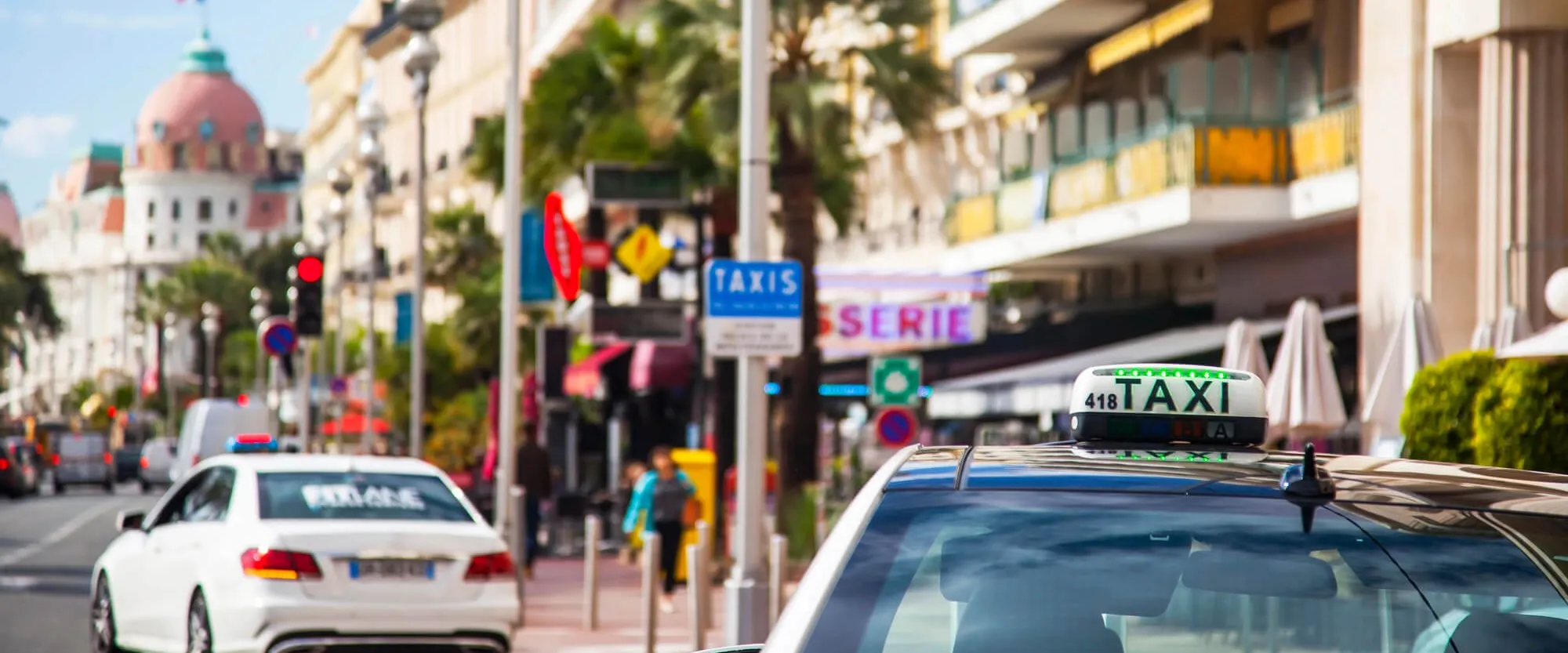
A taxi on the Côte d’Azur runs on a metered system that looks opaque from the back seat, especially if you’re used to a flat app price back home. The meter shows a letter, the number climbs faster on some trips than others, and the same distance can cost wildly different amounts depending on where and when you travel. None of that is the driver improvising. Taxi fares in the Alpes-Maritimes are capped by a prefectural order that’s updated every year, and once you understand the four rates behind the letter on the meter, the price stops being a mystery. This guide explains how the meter works, roughly what common Riviera trips cost, and when a taxi is genuinely worth it over the train.
How the taxi meter works on the Côte d’Azur
Every licensed taxi in the department charges the same way, within maximums set by the Alpes-Maritimes préfecture. Three numbers make up almost any fare:
- The prise en charge (base pickup charge): €4. This is on the meter the moment you set off.
- A per-kilometre rate that depends on which of four tariffs applies (more on that below).
- A minimum fare of €8. However short the ride, supplements included, you won’t pay less than this.
When traffic slows to a crawl or the car is stopped and waiting, the meter switches from charging by distance to charging by time, at €37.54 per hour. On the Riviera’s congested coast road in summer, that time-based portion can quietly become a big part of the fare.
The four tariff rates, A to D, explained
The single letter lit up on the meter (A, B, C, or D) tells you which per-kilometre rate you’re paying. Two things decide it: the time you travel, and whether the driver expects a paying passenger for the return trip.
| Tariff | When it applies | Per km |
|---|---|---|
| A | Daytime, driver likely to get a return fare | €1.30 |
| B | Night, Sunday, or public holiday, with a return fare | €1.65 |
| C | Daytime, driver returns empty | €2.60 |
| D | Night, Sunday, or holiday, driver returns empty | €3.30 |
“Night” runs from 6pm to 9am. Sundays and public holidays are charged at the night rate all day. The letter is legally required to be lit and readable, so you can always see which one you’re on. If you’re on a short daytime hop through town and the meter shows C or D, that’s worth a polite question.
Why leaving town costs more than the trip back
This is the part that catches visitors out. A ride within a town uses tariff A or B, because the driver can reasonably expect another passenger nearby afterwards (retour en charge, returning with a fare). A ride out of town to a village or a different commune uses tariff C or D, because the driver has to come back empty (retour à vide), which roughly doubles the per-kilometre rate.
That’s why a taxi from Nice up to a hill village can feel expensive out of proportion to the distance: you’re effectively paying for the return leg too. It’s also why agreeing the rough cost before you set off, or booking ahead, matters more for out-of-town trips than for a quick ride across Nice.
Supplements: luggage, extra passengers, and tolls
On top of the metered fare, a driver can add only a short, fixed list of supplements and nothing else.
- Extra passengers: €4 for each person from the fifth onward (a driver plus four passengers carries no surcharge).
- Bulky luggage: €2 per bag for items that need outside equipment like a roof rack, and €2 per bag beyond three suitcases. Hand luggage is always free.
- Booking ahead: a reservation supplement of €4 for a Nice taxi, €3 for Cannes or Antibes.
- Motorway tolls: passed on at cost, but only if the driver told you first and you agreed. The péage (toll) has to appear separately on the receipt.
- Snow or ice: up to 10% more, and only on the affected stretch of road, when winter tyres are fitted. Rare on the coast, relevant if you’re heading up to a ski resort.
Taxi fares from Nice Airport
The airport is the one place where fares are fixed rather than metered. Four routes have official flat rates set by the same prefectural order: €32 to Nice city centre, €72 to the Cap d’Antibes and Juan-les-Pins (the rest of Antibes is on the meter), €85 to Cannes, and €95 to Monaco. The €32 rate is for the city centre as the order draws it, east of boulevard Gambetta. If your hotel is out by the airport, at Arénas or Saint-Augustin, that short ride should be metered, so ask the price before you get in and compare it with an app car if the answer is the flat rate. Because the airport has its own set of options, from the tram to helicopters, we’ve covered it separately in the Nice Airport transport guide, including how taxis there compare to Uber, buses, and private transfers.
Roughly what a taxi costs between Riviera towns
Away from those four airport routes, everything runs on the meter, so there’s no official price to quote. The figures below are rough daytime estimates for a one-way trip where the taxi returns empty (tariff C), rounded and including the €4 base charge, so treat them as a sense of scale, not a quote.
| Trip (one way, daytime) | Approximate metered fare |
|---|---|
| Nice ↔ Èze village | €40–55 |
| Nice ↔ Monaco | €60–75 |
| Nice ↔ Antibes | €60–80 |
| Nice ↔ Saint-Paul-de-Vence | €55–70 |
| Nice ↔ Menton | €80–100 |
| Nice ↔ Cannes | €85–105 |
Real fares move with traffic, waiting time, and the clock. Expect noticeably more at night and on Sundays or holidays (tariff D), and more again when summer congestion turns the coast road into a car park and the time-based rate kicks in. If the exact cost matters, book ahead and ask for an estimate, or watch the meter as you go.
How to tell a licensed taxi from someone offering you a lift
This is the part of taxi safety that actually matters, and it has nothing to do with the driver being friendly.
A licensed French taxi carries a roof sign, a meter (taximètre) running on the prefectural rates, and a licence number displayed in the car. It can wait at a rank and be flagged down in the street, a right called maraude that belongs to taxis alone. Take one from a rank, or have a hotel or restaurant call one.
A VTC, the pre-booked private-hire category, is equally legitimate but works differently: it can only carry you on a reservation made in advance, and by law it cannot display a meter or a rooftop light, precisely so it isn’t mistaken for a taxi (our private driver guide covers how those bookings work).
What to refuse is the third category. Anyone who approaches you in an arrivals hall, at a station exit or on the street offering a ride is operating outside both systems. They are not bound by the prefectural tariff, so there is no capped price to appeal to afterwards, and there is no licence number to complain about. Walk to the rank instead, or use a booking you made yourself.
When is a taxi worth it over the bus or train?
For pure cost, public transport wins on the coast without much argument. The regional TER trains link Nice, Monaco, Menton, Antibes, and Cannes for a few euros, and they’re frequent and fast because they skip the traffic entirely. For a solo traveller hopping between coastal towns, the train is almost always the better call, and for a daily journey our guide to commuting on the Côte d’Azur gives each route a verdict.
The maths changes in a few specific situations:
- Hilltop and inland villages. Places like Èze village, Saint-Paul-de-Vence, or Gourdon sit above or away from the rail line, reached by infrequent buses or a steep climb from the nearest station. A taxi drops you at the door.
- Two or more of you. Split between a couple, a €45 fare to a spot that’s a fiddly two-change bus journey is often worth the time and hassle saved. Between three or four, the per-person gap with the bus narrows further.
- Luggage, late nights, or early starts. Buses and trains thin out in the evening and don’t run through the small hours. A taxi is door to door whatever the time.
The honest rule of thumb: take the train along the coast, and save the taxi for the awkward-to-reach places, the late hours, or when there are enough of you to share it.
Private drivers and day trips on the Côte d’Azur
For a single hop, a taxi is fine. For a full day of exploring, the maths turns against it. String together Èze, La Turbie, and Monaco on the corniches, or head inland to Saint-Paul-de-Vence, Grasse, and Gourdon, and a metered taxi charges you for the waiting time at every stop (that €37.54 hourly rate) on top of the higher empty-return rate on each leg. The bill climbs fast, and you still have to find a fresh taxi in each village.
A private driver, a licensed VTC (chauffeur car) booked by the half or full day, is usually the better tool for that kind of trip. You agree a fixed price up front, the same driver waits while you wander each village and drives you on to the next, and many know the coast well enough to double as an informal guide, pointing you to the viewpoints and the quieter times to arrive. Some offer set day-tour itineraries if you’d rather not plan the route yourself. It’s door to door, it carries your bags and shopping, and split between a couple or a small group the cost against a string of separate taxis and train tickets is often closer than you’d expect.
If you want the convenient way to see the Côte d’Azur’s hill villages and coastal towns in a day, our guide to hiring a private driver on the French Riviera covers how VTCs work, what they cost, and how to book a reliable one. The Riviera Locals directory lists English-speaking private drivers and VTC services, including drivers based around Nice who run day trips and airport runs.
Taxis versus Uber and Bolt
In Nice and the larger towns, Uber and Bolt are the budget-minded way to get around, and they work between the coastal towns too. Both quote a price upfront in the app, which many people prefer to a metered fare that moves with traffic, and both usually come in cheaper than a metered taxi on the empty-return out-of-town trips.
Which of the two is cheaper shifts with demand and the time of day, so the simplest approach is to have both apps installed and check them side by side before you book. In central Nice, Cannes, and Antibes their coverage and waiting times are much the same. So are their limits: neither is reliable up in the hill villages, where you can wait a long time or get nothing, and neither operates inside Monaco, which bans foreign ride-hailing apps (use a licensed taxi or the official Taxi Monaco app there). The Nice Airport transport guide covers how Uber and Bolt work at the airport specifically, including the Monaco ban.
How to avoid being overcharged by a taxi
French taxi pricing is tightly regulated, and a few of those rules exist specifically to protect you:
- The fare notice must be displayed, in English too. Every taxi carries a printed price card inside the cabin, and by law the Alpes-Maritimes order requires that information to be available in English as well as French.
- You can always pay by card. A driver can’t set a minimum or refuse card payment, whatever the fare.
- A receipt is compulsory over €25. For anything at or above €25 the driver must give you a printed receipt, and must provide one on request for smaller fares. It can show your name and the start and end points if you ask.
- Watch the tariff letter. If it’s a short daytime ride through town and the meter is on C or D, or the total looks off, you’re within your rights to query it and to file a complaint with the préfecture using the taxi’s roof number.
Frequently asked questions
How much does a taxi cost from Nice to Monaco?
Roughly €60 to €75 one way in the daytime on the meter, more at night, on Sundays and holidays, or in heavy traffic. There’s no fixed price for this route (only the four airport routes are flat rate), so the exact fare depends on the meter. The coastal TER train covers the same trip for a few euros if cost is the priority.
Why did my Riviera taxi cost more than I expected?
Most likely because the trip left town and the driver returned empty, which switches the meter to the higher C or D rate (roughly double the per-kilometre price), or because slow traffic triggered the time-based rate of €37.54 per hour. Night, Sunday, and holiday travel also costs more.
Are Côte d’Azur taxi fares fixed or metered?
Metered, with maximum rates set each year by the Alpes-Maritimes préfecture. The only fixed-price exceptions are four routes to and from Nice Airport (Nice centre, Antibes, Cannes, and Monaco).
Do French Riviera taxis take card payments?
Yes. By law a taxi driver must accept card payment for any fare, of any amount, and can’t set a cash minimum.
Does Uber work in Nice and on the French Riviera?
Yes, in Nice and the larger coastal towns like Cannes and Antibes, where both Uber and Bolt operate. They’re less reliable in the hill villages, where waits can be long, and they don’t work at all in Monaco, which bans foreign ride-hailing apps (use a licensed taxi or the Taxi Monaco app there). To and from the airport, both apps run from a designated pickup point at Nice Airport.
Is it cheaper to take a taxi or the train between Riviera towns?
The train, in almost every case, for coastal towns on the rail line. A taxi becomes worth the extra when you’re heading to a hilltop or inland village off the line, travelling as a group who can split the fare, carrying luggage, or moving late at night when trains and buses have stopped.
Should I take a taxi or hire a private driver for a Côte d’Azur day trip?
For a single destination, a taxi or rideshare is simplest. For a full day visiting several hill villages or coastal towns, a private driver booked by the half or full day is usually better value and far less hassle: you get a fixed price, a driver who waits at each stop, and often local recommendations, instead of paying a metered taxi’s waiting time and hunting for a new one in every village. Browse English-speaking private drivers and VTC services in the directory.
If you’re weighing up transport as part of a bigger move, taxis are one line among many. See the full breakdown of relocation costs for how local transport fits alongside removals, visas, and health insurance.
Official sources for Côte d’Azur taxi fares
- Alpes-Maritimes Préfecture — Taxi fare order (Arrêté n° 2026-051, 15 January 2026)
- Alpes-Maritimes Préfecture — Taxis, VTC and licensing
- Nice Côte d’Azur Airport — Taxi fares and pickup
Find English-speaking private drivers and VTC services in the Riviera Locals directory: transportation · Nice